

BC Poker AML Policy How Security Rules Safeguard Every Transaction

BC Poker AML principles and compliance approach
BC Poker’s AML framework is built around four core principles:
- Prevention – the platform takes proactive steps to identify and block transactions that show signs of illegal origin or intent before they are processed or settled;
- Detection – monitoring systems review transaction patterns and account behaviour continuously, flagging activity that deviates from expected profiles;
- Reporting – where required by applicable regulations or the platform’s licensing conditions, suspicious activity is reported to the relevant authorities;
- Compliance – all financial operations are conducted in alignment with international AML standards and the requirements of the Anjouan licensing framework.
These principles apply equally to crypto and fiat transactions. AML controls are integrated into the deposit, withdrawal, and account management processes and are not a separate layer applied only at specific points. In parallel, the BC Poker bonus code system is replaced by automated reward logic, where bonuses are triggered through deposits, gameplay activity, and promotional eligibility rules instead of manual code entry.
Transaction monitoring and risk detection on BC Poker
All financial transactions on BC Poker are subject to monitoring. This applies to both crypto deposits and withdrawals and fiat payment operations. The monitoring system analyses transaction data in real time to identify activity that may indicate misuse, structuring, or other patterns associated with money laundering.
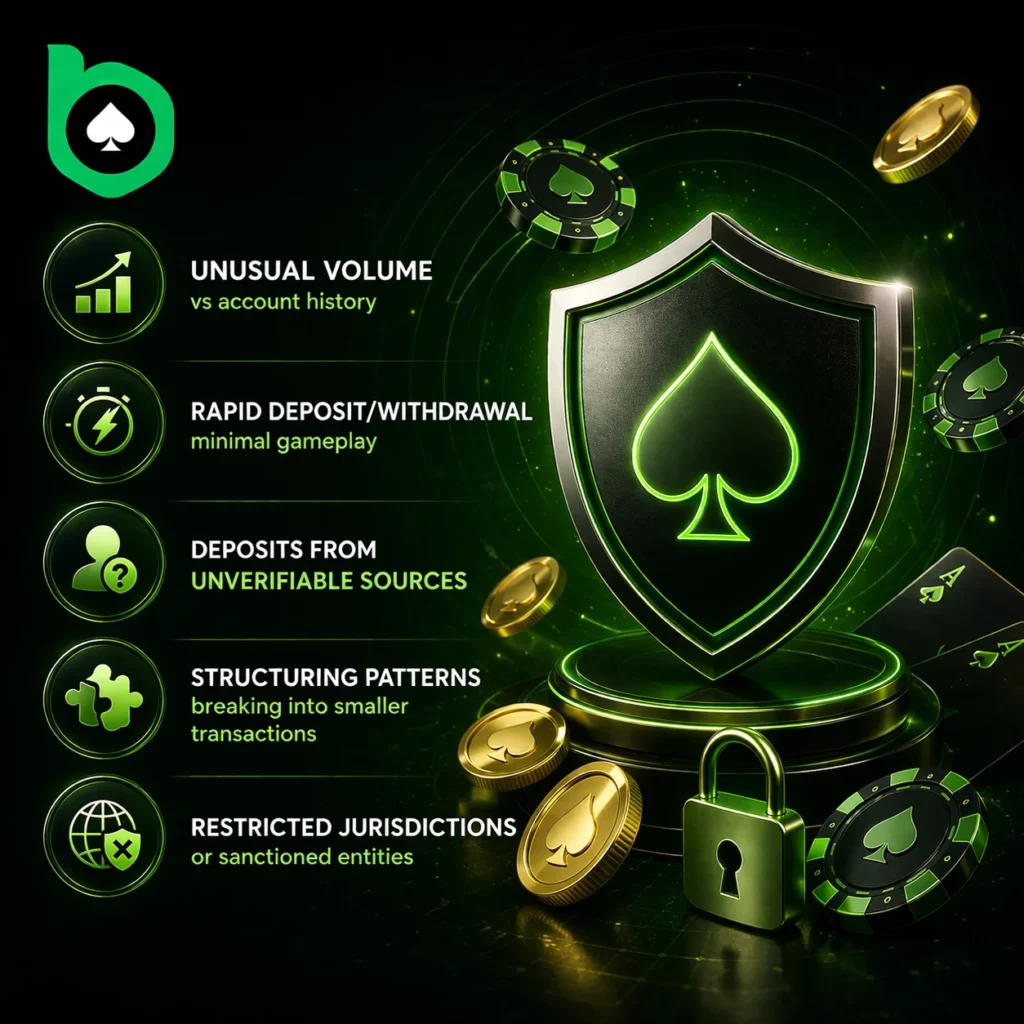
Risk detection covers the following indicators:
- Unusual transaction volumes relative to account history and gameplay activity;
- Rapid deposit and withdrawal sequences with minimal gameplay between them;
- Deposits from sources that cannot be readily linked to the registered account holder;
- Patterns consistent with structuring – breaking larger amounts into smaller transactions to avoid review thresholds;
- Activity from accounts or payment sources associated with restricted jurisdictions or sanctioned entities.
Both automated systems and manual review processes are used. Automated risk controls flag transactions for further assessment; manual review is applied where the automated signal warrants closer examination. BC Poker’s risk management team oversees this process as part of standard operations.
BC Poker verification role within AML framework
KYC (Know Your Customer) verification is not required to start playing on BC Poker. Players can access the poker lobby and make deposits without completing identity checks. Within the AML framework, however, verification serves as a targeted control tool applied in specific circumstances rather than as a universal barrier.
Verification may be requested under the following AML-related conditions:
- A transaction or sequence of transactions triggers a risk review based on the monitoring criteria described above;
- Account activity shows patterns that are inconsistent with the player’s profile or stated information;
- Compliance obligations under the platform’s licence require identity confirmation for specific transaction types or volumes.
When verification is requested, the account may be restricted until the check is completed. This is not a punitive measure – it is a standard control step designed to confirm account ownership and ensure the funds in question are from legitimate sources. Providing the requested documentation typically resolves the review promptly.
User responsibilities and prohibited financial activity
BC Poker’s AML policy places obligations on users as well as on the platform. By registering and transacting on BC Poker, players agree to the following requirements:
- Funds deposited to a BC Poker account must come from legitimate, legally obtained sources;
- The platform must not be used to process, layer, or integrate funds derived from criminal activity;
- Payment accounts used for deposits must belong to the registered account holder – third-party payment methods are not permitted;
- Players must not engage in activity designed to circumvent transaction monitoring, including structuring deposits to fall below review thresholds.
Accounts found to be in breach of these obligations are subject to restriction and fund seizure. In cases where criminal activity is confirmed or suspected, BC Poker will cooperate with relevant regulatory and law enforcement authorities as required under its licensing obligations.
FAQ
What is BC Poker’s AML policy?
It is the framework BC Poker uses to prevent money laundering and other financial crimes. It covers transaction monitoring, risk detection, verification controls, and prohibited activity rules. The policy aligns with international AML standards and the conditions of the Anjouan Gaming Licence.
How does BC Poker monitor transactions?
All deposits and withdrawals are reviewed by automated monitoring systems in real time. Transactions that show unusual patterns – such as rapid deposit/withdrawal cycles or volumes inconsistent with gameplay – are flagged for further review. Both automated and manual review processes are applied.
Does BC Poker require identity verification for all transactions?
No. KYC is not required to start playing or make standard transactions. Verification may be requested when a transaction triggers a risk review, when account activity is inconsistent with the player’s profile, or when compliance obligations require it.
What types of funds are prohibited on BC Poker?
Funds from criminal, illegal, or unauthorised sources must not be deposited on the platform. Third-party payment accounts are also not permitted. Structuring deposits to avoid monitoring thresholds is explicitly prohibited under BC Poker’s AML framework.
What happens if an account is flagged for AML review?
The account may be restricted while the review is in progress. Providing the requested documentation resolves most reviews promptly. Where criminal activity is confirmed or suspected, BC Poker will cooperate with relevant authorities as required by its licence.